Mass and Gravity


In physics, the mass and gravity enigma may be explained with Einstein Spacetime and General Relativity. Indeed, mass and gravity are two very simple phenomena of physics, contrary to preconceived ideas.

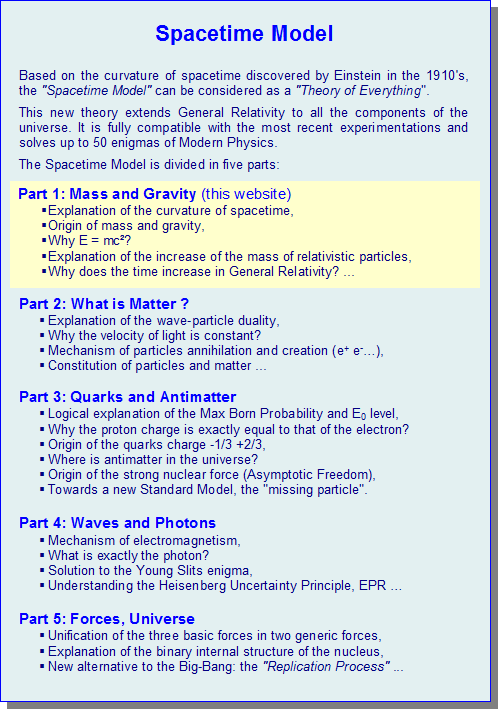
On May 2005, a new theory, the "Spacetime Model", has been deposited and published. This theory, based on Einstein Spacetime and General Relativity, gives the solution to 53 enigmas of quantum mechanics, solves the mass and gravity mystery, and unifies the electroweak, nuclear and gravitational forces in two generic forces.

This webpage is an abstract of the Spacetime Model. It gives a scientific and rational explanation of mass and gravity. It is important to note that, contrary to other well-known models, this new theory uses only four dimensions to fully explain mass and gravity.

The entire theory, a free 220 pages PDF document, may be downloaded from the website specified at the end of this webpage.


Starting point: EFE

Einstein built his Field Equations, or EFE, from the stress tensor of fluid mechanics (19th century). After including results from special relativity, as E=mc², he has identified his tensor to the Riemann Tensor in order to get an equivalence between energy-matter and the spacetime curvature.

The author has remarked two inconsistencies in the construction of EFE:

  1. Einstein has replaced volume, in the original stress tensor, by mass.
  2. He has also replaced the pressure force, in the original stress tensor, by an attractive force, gravity.

Therefore, a question arises: what happens if we re-buid EFE without modifying the sense of the original stress tensor, i.e. saving volume instead mass, and the pressure force instead the Newton Attractive force? The result, explained hereafter, is simply incredible:

It solves the mass and gravity enigma.


1. Curvature of spacetime

Current theory

Scientific authors often represent the spacetime curvature as due to mass by a drawing like figure 1. This representation is very informative but does not answer the question “by which mystery can a mass curve spacetime?”

Einstein's equations connect mass to the spacetime curvature. Consequently, we'll try to understand mass in an indirect manner. Indeed, the solution to this enigma comes from the spacetime curvature.


Explanation of spacetime curvature

Let's fill up a container with water. We drop a billiard ball into water. It is the volume of the ball, and not its mass, which produces a displacement of water.

The same phenomenon applies to spacetime. Contrary to generally accepted ideas, it is not mass which deforms spacetime, but volume (fig. 2).

Notes: 1/The figure was simplified to two dimensions for teaching purposes. 2/ This example does not correspond exactly to spacetime since water is not elastic. It would be more exact to compare spacetime to a kind of deformable crystal or EPP. Since spacetime is elastic, if we remove the central object, the curvature disappears. 3/ The time component of spacetime is also curved. 4/ The constitution of the central object is important. However, this problem is more complex. See the Spacetime Model for further informations (reference of the Spacetime Model site is located at the end of this webpage).

Any volume inserted in spacetime necessarily produces a curvature of it


2. Open and closed volumes

Principle

Let's now replace the billiard ball used in the preceding example by a balloon having the same volume (fig. 3-A). This does not change anything.

However, if we make some holes in the balloon (fig. 3-B), water will go inside it and the displacement of water will disappear.

The same phenomenon also exists in quantum mechanics. We have two main classes of volumes:

  • Closed volumes (fig. 3-A): These volumes, which are nuclear matter, make a displacement of spacetime. As we will see hereafter, spacetime curvature produces a "mass effect". So, closed volumes have a real mass-volume equivalence, which may be written as follow: m = k.v, with k=conversion constant 6.1x10¹⁷ kg/m3 approximately. Quarks, electrons, protons, neutrons, muons, mesons, lambdas... are examples of closed volumes.

  • Open Volumes (fig. 3-B): These volumes exist but do not produce any displacement of spacetime. If there is no curvature, there is no "mass effect" either. Orbitals of atoms are examples of open volumes.

Confirmation

The above explanation is already confirmed by experimentation. Indeed, electrons are moving on empty orbitals already crossed on both sides by spacetime (fig. 4). We know that the atomic mass is concentrated in the nucleus and that orbitals don't have mass. This knowledge of atoms is exactly in accordance with the current explanation: Closed volumes (nucleons and electrons) have a mass whereas open volumes (orbitals) don't.

It means that:

All objects of the universe are combinations of open and closed volumes. For this reason, we have the illusion, on Earth, that mass and volume are two different dimensions.

Note: In reality, it exists five kinds of volumes, and not only two. The real nature of mass has been simplified for teaching purposes. To get a complete description of mass, please see the Spacetime Model (the web site reference is located at the end of this webpage).


3. Gravity

Principle

We have seen that any closed volume (not mass) inserted in spacetime must curve it. Now, let's take the case of two volumes.

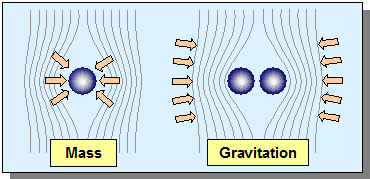
Since spacetime is elastic (Einstein), its curvature produces pressures on these two volumes. This tends to bring them closer to each other (fig. 5).

Therefore, contrary to preconceived ideas,

Gravity is not a mysterious attractive force produced by mass, but a simple pressure force (Hooke Force) exerted by spacetime on volumes.


Synthesis

Mass and gravity phenomena may be summarized as follows:

  • Spacetime is curved by closed volumes, not by masses. Open volumes don't curve spacetime and, consequently, are massless.
  • Since spacetime is elastic, the curvature of spacetime produces a pressure force on closed volumes. This compressive force is what we call "Gravity".
  • Finally, gravity produces a "mass effect" on closed volumes.

It must be noted that volume exists physically, but mass doesn't. Mass is only an effect due to the pressure of spacetime, which is curved by closed volumes. The "mass effect" doesn't exist on volumes which don't produce a curvature of spacetime (open volumes), as orbitals.

The difference between current theory and the Spacetime Model is shown in figures 6 and 7.

Spacetime Model: Any object (with mass) is made of two quantities: a closed volume, which curves spacetime, and a "mass effect" due to the curvature of spacetime which produces a pressure force. Therefore, a "mass effect" is associated to each closed volume. As shown on figure 7, only volume physically exists. Mass doesn't exist in concrete terms. Mass is an "effect" of spacetime. This phenomenon is the same when a car is moving at the speed v. The car exists in concrete terms, but its speed is a only an effect, or a virtual quantity, as cinetic energy or forces. When we solve the formula E=1/2 mv², we have a combination of material and virtual quantities: a physical term, the mass of the car, and effects or virtual quantities, its speed and energy. So, this equation is not homogenous. Saying "mass is a virtual effect" make this equation homogenous since all quantitites are virtual.


Example 1

Let's try to understand the above explanation of mass-volume equivalence with a simple example. On our left, we have an eraser, and on our right, a pen that weighs three times more.

  • If we remove the 99.999% of vacuum existing inside the atoms of the two objects, we obtain two "heaps" of nucleons, one for the eraser, one for the pen, (electrons are excluded for teaching purposes)
  • We will have three times more nucleons for the pen than for the eraser because all the mass is concentrated in the nucleus,
  • Since the volume of a neutron is closed to that of a proton, the pen nucleons will have a total volume three times superior to those of the eraser,
  • Therefore, the pen will produce 3X more curvature of spacetime than the eraser since it have 3X more nucleons, or closed volumes,
  • Finally, this spacetime curvature will produce a pressure three times stronger over the pen than over the eraser in the pen/eraser–Earth context.

In conclusion, the pen will seems three times heavier than the eraser. In reality, it is the spacetime pressure that is three times stronger.


Example 2

This second example shows that we have preconceived ideas concerning mass and volume. Let's take two similar situations.

  • Electrons and nucleus (fig. 8-A). Matter is made of differents molecules. The volume of objects, or more precisely the atomic volume, is calculated from atom orbitals, or "open volumes".
  • Earth and moon (fig. 8-B). The principle of moon orbiting around the Earth is exactly the same as electrons orbiting around the nucleus. However, when we are speaking about volume, what do we take into account? 1/ Earth and moon volumes separately or 2/ The orbital volume of the moon around the Earth, as in atoms... Of course, we think Earth or moon volume, or "closed volumes", and not the moon orbit volume, which doesn't make sense.
Curiously, in two similar situations, sometimes we think "open volume" (orbitals in atoms), other times we think exactly the opposite, "closed volume" (Earth-moon context)...


Example 3

It may be difficult to identify the pressure of spacetime to the "mass effect". Let's imagine that you hold a very light polystyrene ball in your hand with a null mass (fig. 9). In this third example, a flexible polystyrene foam replaces spacetime.

The curvature of the foam, or spacetime, produces a pressure on the top of the ball, toward Earth (not represented for teaching purposes). If you close yours eyes, you will sense the ball heavier if the polystyrene foam is present. It is not the mass of the ball, which increases, but the pressure on the top of it. The result is the same.

This is what we call the "mass effect".

As we see in this simple example, mass is directly related to the pressure of the flexible polystyrene foam on the ball. It means that mass, physically, doesn't exist per se. Mass is a consequence of the spacetime pressure on volumes.


Conclusions

In conclusion, the following points must be noted:

  • Only four dimensions are necessary to fully define mass and gravity. Mass and gravity are not so a complicated phenomena invoquing additional dimensions. Indeed, it is not necessary to envisage extra dimensions to explain mass and gravity.
  • The Spacetime Model exactly matches Einstein's ideas: "The universe would have only 4 dimensions, no one more". It's not a proof per see, but an important indication.
  • This explanation of mass and gravity is in accordance with the constitution of atoms: nucleus is a closed volume with mass, and orbitals are massless open volumes.
  • The mass and gravity phenomena already exists on Earth, like our example of a billard ball into water. Since we know that Nature always tends to repeat itself, the "Spacetime Model" is a credible theory.
  • This explanation is in perfect accordance with the Stress Tensor used in fluid mechanics, which is at the origin of Einstein Field Equations.
  • At last, mathematical equations are unchanged. We may continue to use "m", or its equivalence with m=k.v.
In other words, the above explanation of mass and gravity is much more credible than all that complicated theories which doesn't give the answer to the two simple questions: What is mass? What is gravity?


The Spacetime Model

The explanation of the mass and gravity described in this web page is the second part of the Spacetime Model:

  • Part 1: Wave-Particle duality, constitution of particles
  • Part 2: Mass and gravity
  • Part 3: Quarks, antimatter, nuclear force
  • Part 4: Electromagnetism
  • Part 5: Nucleus, unification of forces, the universe

To download each part separately (five PDF files of 40-50 pages each) or the entire theory (a free 220 pages PDF document), please go to the following website:

www.Spacetime-Model.com

The entire document can also be downloaded on Google Books

Other Author's Websites:

www.higgs-boson.org

www.wave-particle-duality.com

Author: Jacky JEROME

Last update: 31 march 2008, Site designer author@spacetime-model.com